Urban VIII, Bernini, and Saint Peter’s
by Elizabeth Lev, appearing in Volume 50
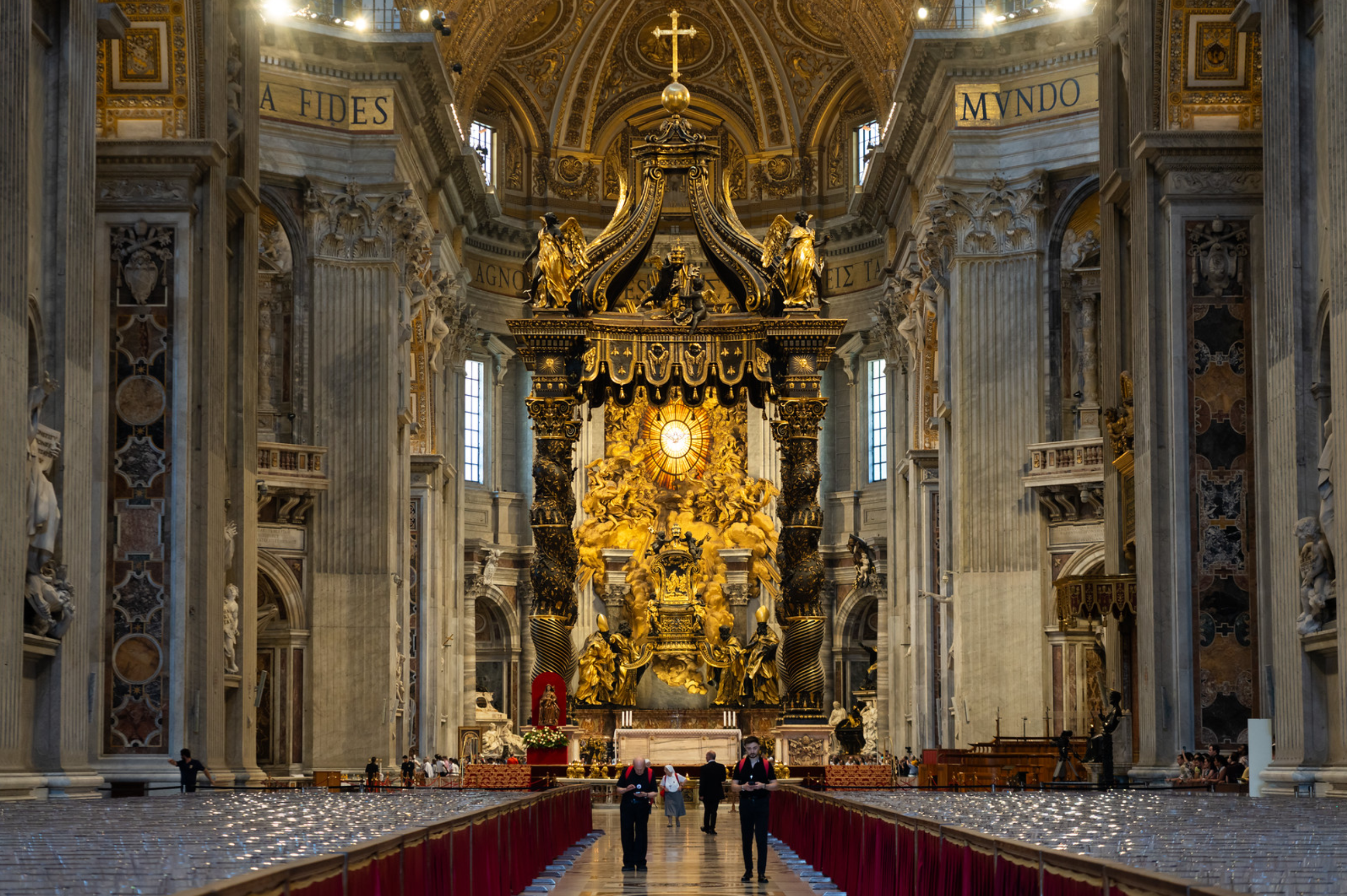
Biographers record that on August 6, 1623, the night of his election to the pontificate, Pope Urban VIII Barberini summoned the twenty-five-year-old Gian Lorenzo Bernini to his chambers and said, “It is a great fortune for you Mr. Bernini, that I have been made pope, but an even greater fortune for me to be pope in your lifetime.” With these words, the artist and the successor of Saint Peter embarked on an artistic endeavor of a lifetime: the decoration of the new Saint Peter’s Basilica.
The new church had been under construction for over a century. Work commenced in 1506, when Pope Julius II, dismayed by the deteriorating condition of the 1100-year-old Constantinian basilica, approved Bramante’s daring plan to rebuild the church in an innovative modern manner. Twelve popes and twenty architects later, the worksite had endured the sack of Rome, the Protestant Reformation, and warring architects, finally emerging in 1590 with Michelangelo’s massive cupola rising above a Greek-cross plan.
But the long delay in construction saw the rise of a new problem: Saint Peter’s Basilica served as the parish church of the world, and from the time Bramante first broke ground, “new worlds” were discovered with alarming regularity. Bramante’s church was soon revealed to be too small. To gain more space, in 1607 Carlo Maderno was directed to extend the church to almost double Bramante’s plan. The result was a 610-foot-long interior with a capacity of 60,000 people standing (20,000 seated). How to decorate a structure the length of two football fields? Furthermore, in the wake of the Council of Trent, several figures from Palladio to Philip Neri advocated for unadorned, whitewashed church interiors, but in Saint Peter’s, bare walls would have transformed the space into little more than an airplane hangar.
Pope Urban VIII, who had opposed the addition, inherited the responsibility of decorating the vast expanse along with his tiara. He turned to the young Bernini who would become the “new Michelangelo” to his “new Julius II.”
The first challenge was how to focus attention on the tomb of Saint Peter in the cavernous space. In the earlier design, it was visible from the entrance situated at the core of the church under Michelangelo’s cupola. With the extension, the dome was no longer visible from the entrance. After the start of the Protestant Reformation, underscoring Peter’s presence had an added urgency amid the reformers’ rejection of the papal magisterium. Pilgrims needed to be oriented to the site of the first pope, the rock upon which Christ built his Church.
At the same time, the main altar of the basilica was lodged in the apse where there was space for the pope, his court, and his choir. Post-Tridentine churches emphasized the visibility of the altar, removing centuries-old rood screens to permit greater participation by the faithful. Any solution for the tomb of Saint Peter would have to allow for the faithful to see through the monument to the immense apse 100 feet beyond the tomb. Urban VIII was open to ideas… and young Gian Lorenzo Bernini had plenty of them.
In the basilica, the tomb of the apostle was occasionally decorated with temporary baldachins made of wooden staves and cloth. Bernini imagined a gigantic, ninety-five-foot-tall durable version of this ephemeral decoration made out of bronze, the only material that could stand so tall and yet use slender supports. Bernini made model after model, then hired Francesco Borromini to produce perspective drawings to get a sense of the proportions, adjusting the design to better fill the space. From the beginning, Bernini and the pope agreed on twisting columns, called Solomonic because this was thought to be the design of the columns at the Temple of Jerusalem, and in homage to the exotic marble columns donated by Constantine or his sons that framed the apostle’s tomb in the old basilica. The columns evoked Saint Peter’s journey from the East to Rome, bearing the Gospel message that upended the Roman way of “ordering” life. Jarring, surprising, and far from the neat Doric and Ionic orders of Greece and Rome, these columns not only testified to the antiquity of the church but also reminded the beholder of the challenging nature of the Christian message.
Urban had no intention of jettisoning the ancient vestiges, however. The twisted columns from the old basilica were re-purposed to stand sentinel over the most important relics of the church after those of Saint Peter: Veronica’s cloth with its imprint of the face of Christ, a fragment of the spear used to pierce Christ’s side, the cross of Christ’s crucifixion, and the head of Saint Andrew. Each relic shrine was embellished with a statue of the saint associated with the relic, carved by Rome’s most established sculptors, including Bernini himself, who sculpted the dazzling Saint Longinus, the Roman centurion at the foot of the cross who is shown windswept and astonished as he declares “Truly this was the Son of God.” Two men and two women are featured around the tomb of Saint Peter, a visual complement in a city that equally celebrated the extraordinary lives of its male and female saints.
One of Urban VIII’s most underrated additions to the basilica was in honor of an exceptional woman, Matilda of Tuscany, the eleventh-century countess who had defended the Church against the encroachments of the Holy Roman Emperor. Urban VIII ordered her remains brought to the basilica and commissioned Bernini to build her a new tomb. Matilda was depicted as a classical heroine, donning a breastplate and brandishing a sceptre while cradling the papal keys and tiara.
Relics, royals, and recycling aside, Urban’s mission was to revitalize the church around the remains of its first pope, Saint Peter. In anticipation of the 400th anniversary of the basilica, the Knights of Columbus funded the restoration of the baldacchino, assuring its continued stability and cleaning the bronze dulled by time. The most striking transformation was the renewal of the gilded elements, from the angels perched at its angles to the putti draping garlands, and the ubiquitous bees buzzing around the golden leaves. The bees, heraldic symbol of the Barberini family, allude to hard work, sweet eloquence, and the sharp sting in defence of the faith. The cleaning of the gilding, however, reveals a more important purpose: catching the eye of pilgrims as they cross the threshold of the basilica. The bright baldacchino acts almost as a neon sign guiding the eye to the tomb of Peter and the papal altar erected above it.
Finally, Urban captured an element of the supernatural in the surprising work. Baldacchins were generally made of cloth, and Bernini’s bronze confection recreated tasselled panels around the outer edge of the covering. Upon closer inspection, however, some of the panels seem slightly raised, their tassels wafting in the wind. Where is the wind coming from? Beneath the elaborate volutes crowning the canopy, Bernini cast a golden dove, symbolic of the Holy Spirit, directly above the altar. This dove is reminiscent of Jesus’ words immediately after his resurrection when he breathed on the apostles and said “Receive the Holy Spirit. Whose sins you forgive are forgiven them, and whose sins you retain are retained.” (John 20:22-23). Bernini’s fluttering panels evoke the first stirrings of the Holy Spirit and the power bestowed on the apostles, and they set the stage for Bernini’s monument of the Chair of Saint Peter twenty-five years later.
Urban consecrated the new Saint Peter’s Basilica on November 18, 1626, an event commemorated in the glorious tapestry designed by Pietro da Cortona and featuring a cameo appearance by Gian Lorenzo Bernini. Urban’s work was heavily criticized, however, for its extravagance, its jarring design, and wrongly, for its appropriation of bronze from the Pantheon. “Quod non fecerunt barbari, fecerunt Barberini” (“That which the barbarians didn’t do, the Barberini did”) went the old satirical Pasquinade. And although Urban did remove bronze from the Pantheon porch, it was used primarily for artillery at Castel Sant’Angelo rather than for the baldacchino of Saint Peter’s.
After a frenetic twenty-year pontificate, Urban VIII died on July 29, 1644, and was laid to rest in his last embellishment for the church, his funerary monument designed by Bernini. The innovative project placed the bronze effigy of the seated pope at the apex of a triangular composition. His raised hand emulates less the gesture of blessing seen in Arnolfo di Cambio’s nearby bronze statue of Saint Peter and more the powerful position of the equestrian statue of Marcus Aurelius. The pope gazes down towards the basilica he consecrated while the hopeful personification of charity lifts her child to him and heartbroken justice looks for her next patron. Between the two virtues, a gilt skeleton rises from the tomb, inscribing the pope’s name in the book of the dead.
This transformative pontificate, dedicated to the preservation of the tomb of Peter and the renewal of papal prestige, may have been interrupted by death, but the beauty sponsored by Urban VIII lives on.