Ten Myths of Saint Peter’s
by Duncan G. Stroik, appearing in Volume 50
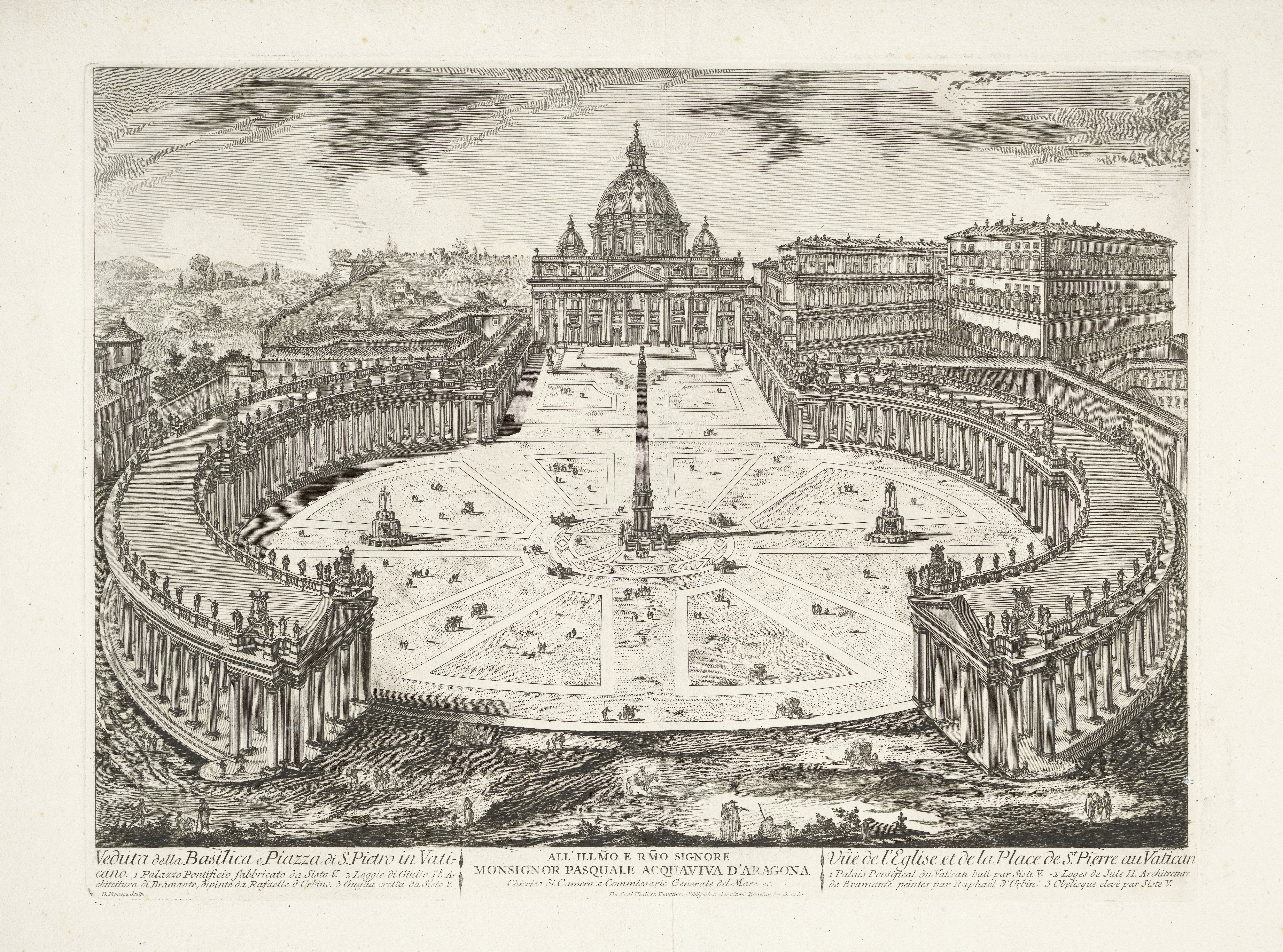
Built above the bones of the first pope, Saint Peter’s Basilica in Rome has been the center of the Vatican and the Roman Catholic Church for centuries. It is a magnificent building with tombs of saints, more than forty side altars, and home to many famous works of art including Michelangelo’s Pietà and the Cathedra Petri by Bernini.
I would argue that it is the most beautiful church in the world. One thing I love about Saint Peter’s is that it would be very hard to recreate what brought it about in the twenty-first century. Not just because of the feats of engineering, the use of expensive travertine, the carvings, the pilasters (which are eighty-five-feet tall) or the dome (which has chains around it to restrain the thrusts), but because it is the product of fifteen different architects. You would not know where one architect’s work ends and another begins unless you were an expert on the building. They speak the same architectural language—what we might call the ecclesiastical “Latin” of architecture. They were different men with varied talents, some more famous than others—among them Bramante, Michelangelo, Bernini, and the painter Raphael. But they made one cohesive masterpiece.
Unsurprisingly for a famous building with 1700 years of history, some of the things commonly believed about Saint Peter’s are not true. I call these the “myths” of Saint Peter’s. Here I present ten that I encounter often.
1. The Gothic Cathedrals took hundreds of years to build, but Saint Peter’s was built quickly.
In fact, the opposite was true. For instance, the major part of the work of Notre-Dame de Chartres was completed in about twenty-five years (1194-1221) while the new Saint Peter’s was built in 120 years (1506-1626). The piazza took another forty years to finish, adding up to 160 years total.
Some Gothic cathedrals did take over 100 years to build, but many were fewer. Notre-Dame de Laon took sixty years. Notre-Dame d’Amiens: eighty-five years, Notre-Dame de Reims: eighty-one years, and Notre-Dame de Paris took 107 years for the nave structure and body of the cathedral. The idea that many took hundreds of years seems to be inspired by the fact that after they were built, they continued to have major renovations or additions.
2. Saint Peter’s was built as a church, and for papal liturgies.
Certainly Saint John Lateran, the cathedral of Rome, started out as a church. Santa Maria Maggiore across town was built as a church. But Saint Peter’s was built primarily as a monument to the first bishop of Rome, the fisherman and prince of the apostles, Saint Peter. This is particularly clear when you see excavations in the 1930s and 40s, which discovered that “Petros eni” was written on the walls of his tomb around 180 A.D., which means, “Peter is here” or “Peter is within.”
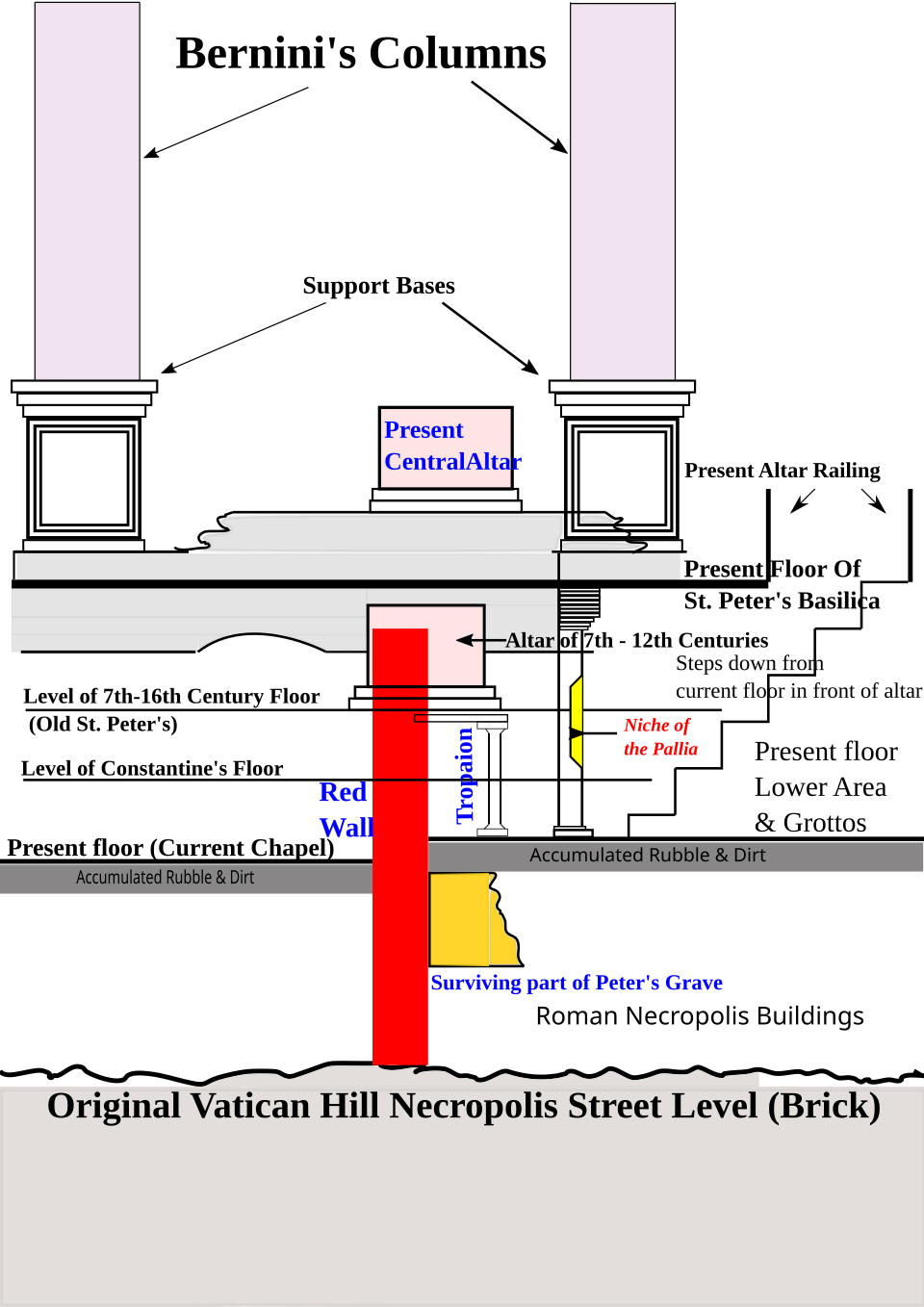
We have some reconstructions of what the first structures over his tomb looked like: the so-called “Trophy of Gaius.” The trophy was a monument over Saint Peter’s tomb. Eventually, it became an altar after the Edict of Milan. And because Peter was buried underneath, others wanted to be buried nearby. Thus, rather than as a place for liturgy, Saint Peter’s was built as a covered cemetery. Other churches in Rome, such as Sant’Agnese fuori le Mura, were also built as covered cemeteries, and secondarily Mass was said there. Saint Peter’s was a place of burial for the apostle and for people awaiting the Resurrection. By the time of the Renaissance, Saint Peter’s was a nave filled with tombs and altars.
3. All the Popes are buried in Saint Peter’s basilica.
Many popes are, but not all. Over the centuries, only 148 out of 264 popes have been interred at the Vatican, and there are only ninety there presently. Where are the others buried? Approximately thirty popes are buried in the ancient catacombs outside the city walls of Rome. Twenty-two are in the Cathedral Basilica of Saint John Lateran, two in the basilica of San Paolo fuori le Mura near the tomb of the Apostle Paul, eight including Pope Francis in Santa Maria Maggiore, five in the Dominican church of Santa Maria Sopra Minerva including the Medici popes Leo X and Clement VII, and two each in Sant’Andrea della Valle and Santa Maria in Monserrato. In addition, around thirty Bishops of Rome are buried elsewhere in Italy, France, and Germany.
4. Saint Peter’s was built by Emperor Constantine.
We know that Constantine built the Cathedral of the Most Holy Savior, now also known as Saint John Lateran, in 324. He worked with Pope Saint Sylvester to build it, and there are textual records from the time. There is also a tradition that he was baptized in the octagonal baptistry next door. We also have evidence that he paid for the building, and he gave a pediment (“fastigium”) with four bronze columns along with silver and gold lamps to adorn it. We also know that the land he built it on was partially owned by his wife.
We have no such proof that Constantine built Saint Peter’s. We know he built Christian temples in Rome, the Holy Land, and in his new capital of Constantinople, all documented by Eusebius de Caeserea. But there is no mention of Saint Peter’s. Constantine had a devotion to certain saints, but there is no evidence that Saint Peter was one of them.
Other evidence suggests that Saint Peter’s may have been built by his sons Constans (ruled 337-350 AD) and Constantius II (ruled 337-361 AD) after Constantine’s death in 337. Some of the bricks from Saint Peter’s had a stamp from the time of Emperor Constans, so we know that at least some of old Saint Peter’s was built by Constans; and probably the whole building was built by Constantine’s progeny.
5. The building of Saint Peter’s caused the Protestant Reformation because money from the sale of indulgences was used to build Saint Peter’s.
First, indulgences are not “sold.” Sacrifices, including donations of money, can be made to reduce time in purgatory. This is what an “indulgence” is. But second, money collected from indulgences was only a fraction of the cost of construction. The causes of the Protestant Reformation are many: nationalism, strong monarchies, the Black Death, and corruption. When Martin Luther posted the 95 Theses, money from indulgences was being used more for other things than for building Saint Peter’s. Some money was directed to Saint Peter’s, but it was not the main source of funding. The majority of construction costs were financed through tithes, royal gifts, sale of church offices, and papal taxes.
6. The original plan of the new basilica by Bramante was a centralized church with a dome, but the cardinals wanted a longitudinal church.
By the early Renaissance, the original Saint Peter’s basilica was in bad shape structurally. The four-foot-thick walls were leaning by six feet in some places. Think of the tower in Pisa with walls a football field long. The old basilica lasted from c.337-1500, so perhaps its structural problems could be forgiven. I would love to build a church that lasts for 120 years, let alone 1,200. In any case, when Pope Julius II came along, he hired architect Donato Bramante, from Urbino, to substantially renovate the old basilica or build a new one.
Bramante’s original design was centralized and has become known as the “snowflake design.” The accepted belief is that Bramante designed a centralized church plan with Julius II, but it wasn’t built because the cardinals were worried about things like liturgy and procession. They supposedly did not understand the beauty of the subtle geometry with man placed at the center of the dome, like the drawing of the Vitruvian man inside the circle and square by Leonardo da Vinci, so they wrecked Bramante’s plan by adding a nave. This is a very nice story, except we lack the evidence for it.
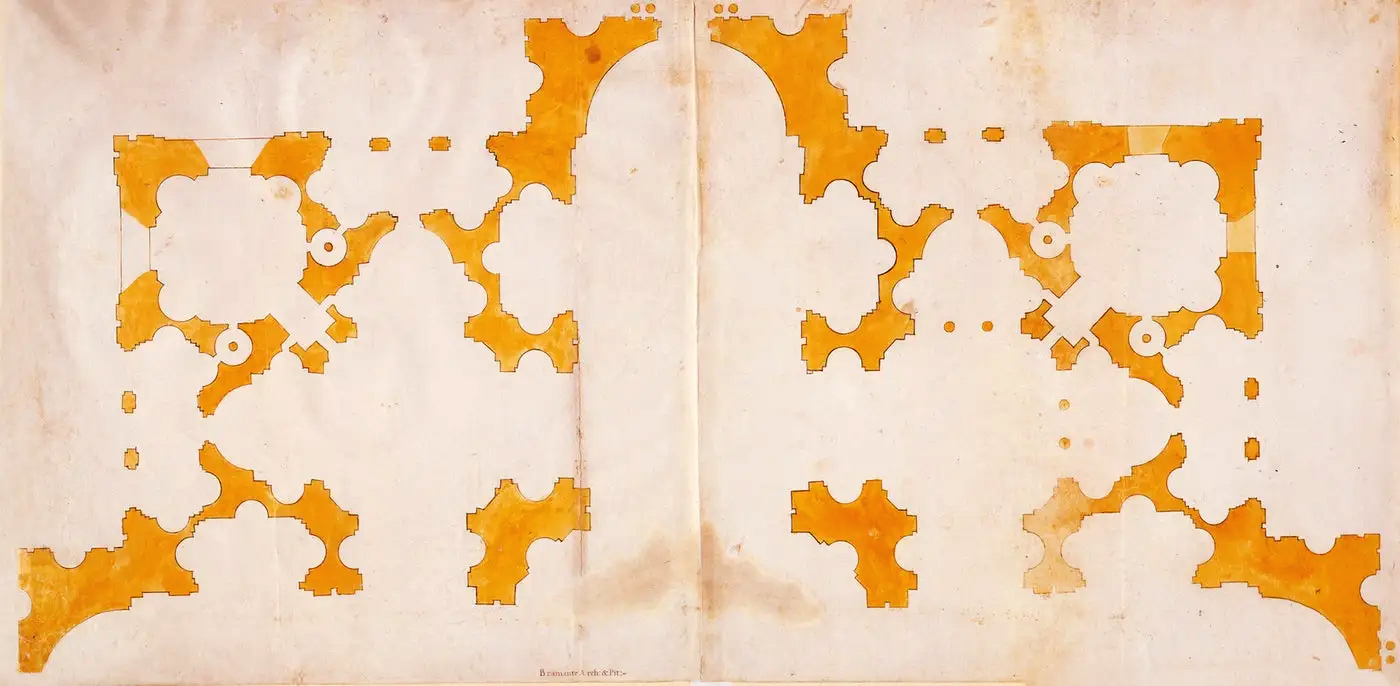
One would think there must be a drawing by Bramante of the snowflake plan showing a Greek cross with a dome in the middle. But all we have is a drawing by Bramante which shows half of the centralized plan. We do not have a centralized church drawing. Modern historians took the plan and mirrored it to come up with the “snowflake.” There is no reason that Bramante’s half plan could not have been part of a cruciform design with a long nave and a dome as proposed by almost all of the architects after Bramante.
The exception to the longitudinal cruciform design was the design by Michelangelo, who wanted to build a centralized church. His plan, about forty years after Bramante’s, proposes just such a plan. But Pope Paul V hired Maderno who lengthened the nave so that the church would fit 25,000 people, instead of the 12,000 that could have fit in Michelangelo’s brilliant, but much smaller, plan.
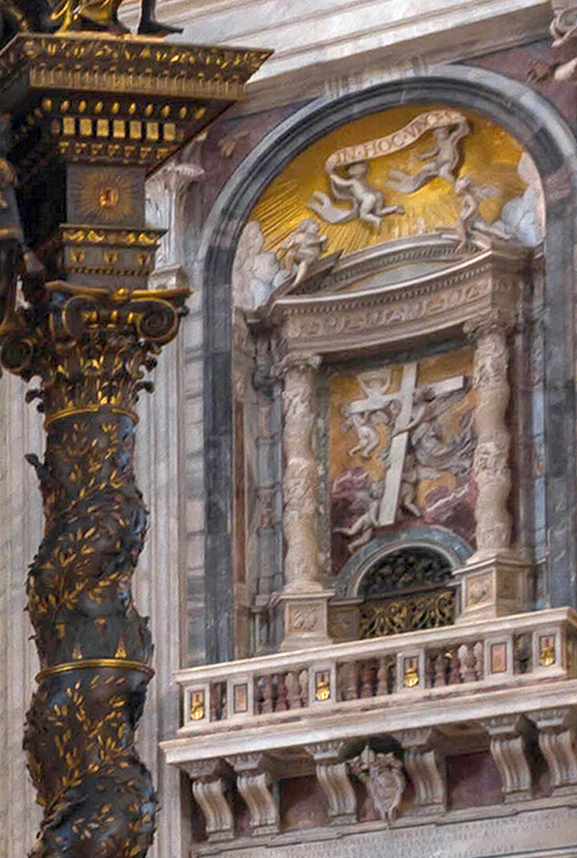
7. The Solomonic baldacchino columns at the high altar by Bernini are made of bronze melted down from the ceiling of the Pantheon portico.
In fact, it is true that the ancient barrel-vaulted bronze ceiling in the portico of the Pantheon was removed and melted down by Pope Urban VIII Barberini. He needed cannons to defend the Papal States, so he took the bronze from the Pantheon and recast it as weapons of war. When the people found out, they were very unhappy, and someone wrote the famous quote, “Quod non fecerunt barbari, fecerunt Barberini” (what the barbarians did not do, the Barberini did). So, the Pope told them that he was using the bronze to make the baldacchino columns, which seemed like a more acceptable purpose.
In fact, it was the same foundry that did both the columns and the cannons. But the bronze of the columns has been analyzed and there is no bronze from the Pantheon in them. Centuries later, the columns are still there, but the cannons are not. Even so, they were not produced by melting down the ceiling of the Pantheon portico.
8. Saint Peter’s has forty huge painted altarpieces.
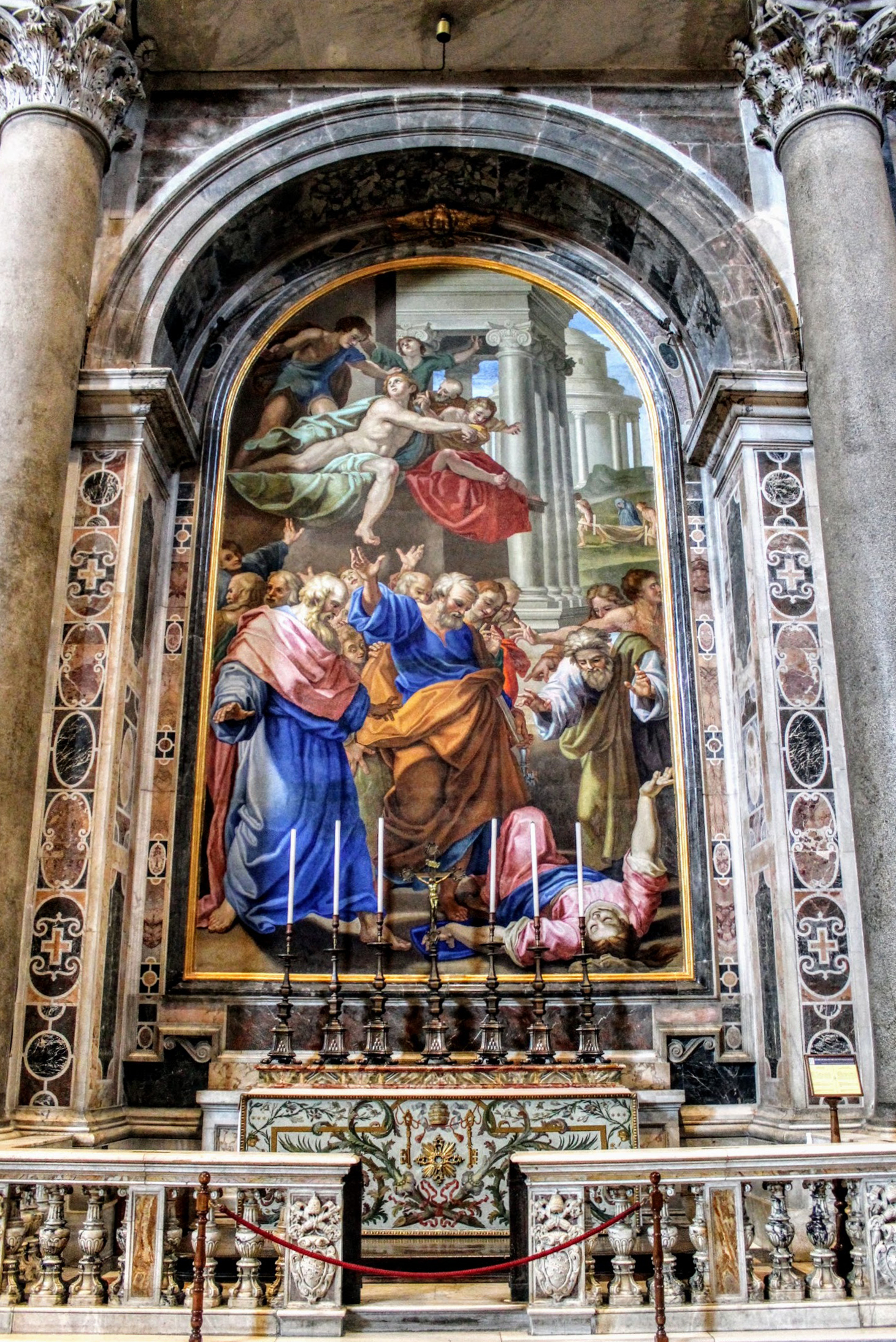
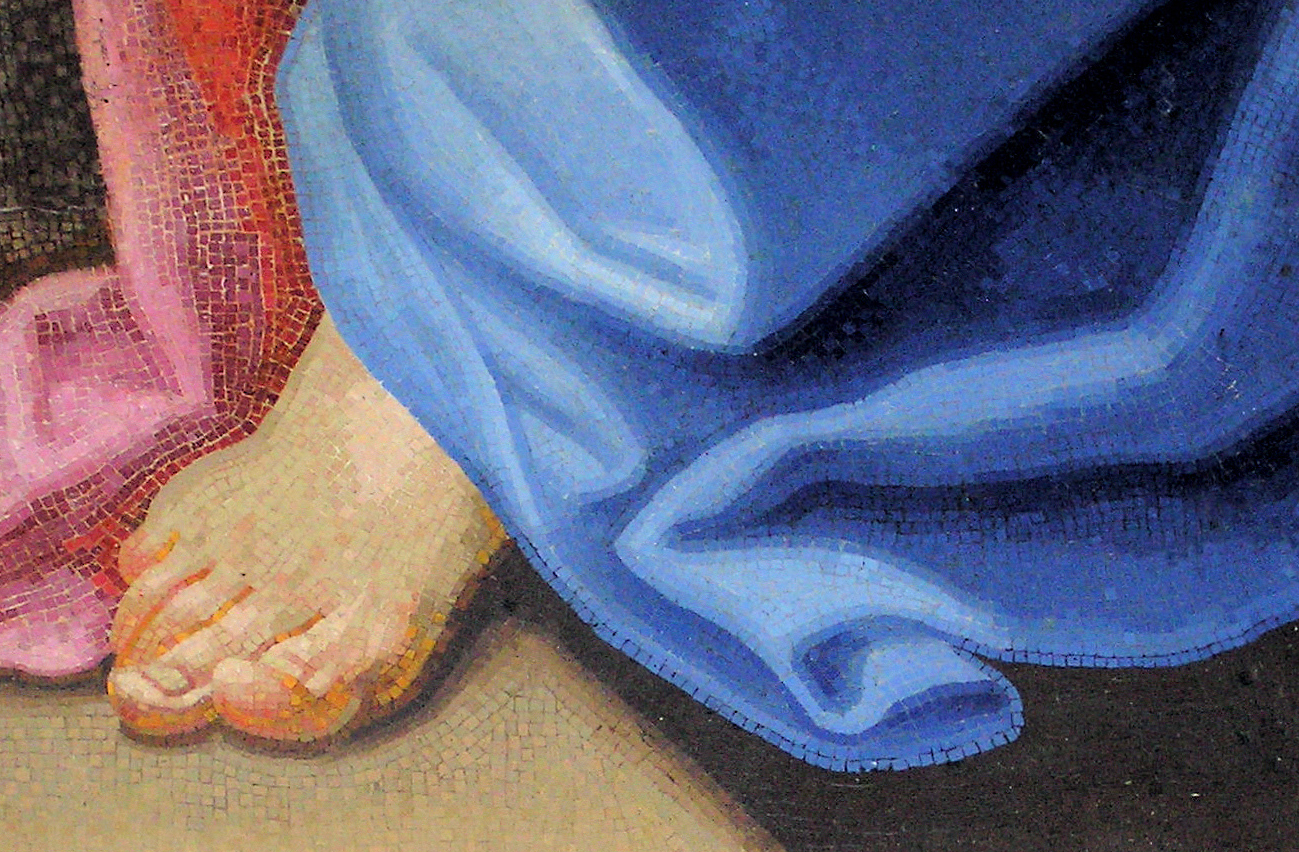
There are forty-plus altarpieces in Saint Peter’s, yes—but they are mosaics, not paintings. They were made by the Vatican mosaic shop, which has its own mosaic tradition, distinct from the traditions of Tuscany, Ravenna, and Venice. Their mosaics are made to approximate paint. When you look closely at an altarpiece in Saint Peter’s, you will see that it is made out of tiny fired bits of clay, so close in color that they approximate painting. Indeed, these altarpieces started their life as oil paintings, sometimes of irregular sizes. Later, in order to regularize them, the Vatican Mosaic Shop replaced the oil paintings with mosaics in the eighteenth and nineteenth centuries and put the paintings in the Vatican Museum.
So there are not forty painted altarpieces in Saint Peter’s. But are they all mosaics? All but one. The Blessed Sacrament Chapel in Saint Peter’s has an amazing tabernacle by Bernini with two angels, and above it, the Holy Trinity by Pietro da Cortona. This is the single oil painting in the basilica.
9. The original Saint Peter’s was built with a versus populum altar.
Saint Peter’s has a versus populum altar today, but it is the result of a particular history related to the early developments in church orientation. Saint Peter’s was built on a hill with its front door facing east toward the city of Rome. Since the eighth century, most great churches have been built with the altar in the east and the front door in the west, leading us to say that Saint Peter’s was built “backwards.” In Saint Peter’s, the priest faced east toward the rising sun, which happened to be towards the front door. During the Eucharistic Prayer, the people in the nave would also turn around, like the priest, and face east. So, they were all facing the door together. They tried this for about 200 years, but it was awkward to turn, so by the sixth century the priest would face east, but the people remained facing the altar. So, the freestanding altar with the priest standing behind it seems today like it is situated versus populum (toward the people) whereas it was originally situated versus Deum (toward God).
10. Saint Peter’s has the largest dome in the world.
Some of the greatest domes in the world include Il Duomo (Florence), Saint Peter’s (Rome), the Pantheon (Rome), Saint Paul’s (London), and the U.S. Capitol Building (Washington, D.C.). The Roman Pantheon, by far the oldest, has a diameter of 142 feet. It is also 142 feet tall: half a football field. Santa Maria del Fiore, the Duomo in Florence with an octagonal dome by Brunelleschi, is 143 feet in diameter. In height it is 320 feet: a football field plus an end zone. Saint Peter’s dome by Michelangelo has a diameter of 141 feet, one foot smaller than the Pantheon and two feet short of Florence. Michelangelo imitated the Duomo, and the Duomo was imitating the Pantheon. In height, Saint Peters is 394 feet: a football field, both end zones, and the marching band. Of the three, Saint Peter’s is slightly narrower in width, but it is the tallest masonry dome in the world.
Despite the myths surrounding it, Saint Peter’s Basilica is an enduring monument to the Church and her patronage of the arts. Built by fifteen architects over 160 years, it is a masterpiece of human achievement for the glory of God. May it stand for many thousands of years to come.