Raphael in New York City
by Caroline Cole, appearing in Volume 50
Raffaello Sanzio da Urbino (1483-1520) never traveled outside Italy, but his drawings and paintings have made their way into museum collections around the world. Last spring, 175 of these were brought together for an exhibit at The Metropolitan Museum of Art in New York City.
The organization of the exhibit traced the development of Raphael’s style and career. Works by his immediate predecessors introduced the visitor to the artistic world that Raphael was born into on April 6, 1483 (Good Friday), in Urbino. One of these predecessors was his father, Giovanni Santi. A female saint painted by the elder Santi in the exhibition shows that he had considerable skill. Giovanni was also a poet, and a manuscript of his poem about the life of Federico da Montefeltro was on display. Federico was the famous duke who ruled Urbino from 1444 to 1482 and made it a major center of the arts in the early Renaissance.
Giovanni’s artistic efforts are admirable, but to my mind, his most enduring legacy in the world of art was his recommendation to Pietro Perugino to take his young son Raphael as an apprentice. Raphael was the only surviving child of Giovanni’s first wife, Magia di Battista di Niccolò Ciarla. A touching inclusion in the exhibit was a ledger of wax purchases from the convent of San Francesco d’Assisi in Urbino. The ledger records candles used for the funeral of a younger infant brother of Raphael’s, and a few years later, candles for the funeral of Magia and Raphael’s infant sister. Raphael began in Perugino’s workshop in 1494 at age 11, the same year his father passed away.
Pietro Perugino (1446-1523) was considered one of the finest artists of his time, having completed frescoes on the walls of the Sistine Chapel for Pope Sixtus IV. He managed a large workshop and was effective in the ‘business’ side of his art, skills that Raphael learned alongside his training in painting. Raphael’s early paintings show that he imitated his master’s style closely. Perugino often employed an arrangement of figures in an altarpiece with one central seated figure and others grouped symmetrically around. Raphael used this arrangement in his famous Madonna and Child Enthroned with Saints, 1504-1505, originally commissioned for the nuns’ choir of Sant’Antonio di Padova in Perugia, now known as the “Colonna altarpiece.” Five small paintings that were on the predella beneath the altarpiece, all by Raphael, were brought back together from four different museum collections to be displayed with the altarpiece for just the second time since 1663.
Raphael moved to Florence in 1504, and his style developed there beyond what he had learned from Perugino. The exhibition pointed to two major influences: Leonardo da Vinci and Michelangelo. From Leonardo, Raphael picked up a method of “quick drawing”—initial sketches that are rough and lively, conveying expression and emotion in just a few lines. From Michelangelo, Raphael began to imitate his characteristic style of dynamic, muscular bodies.
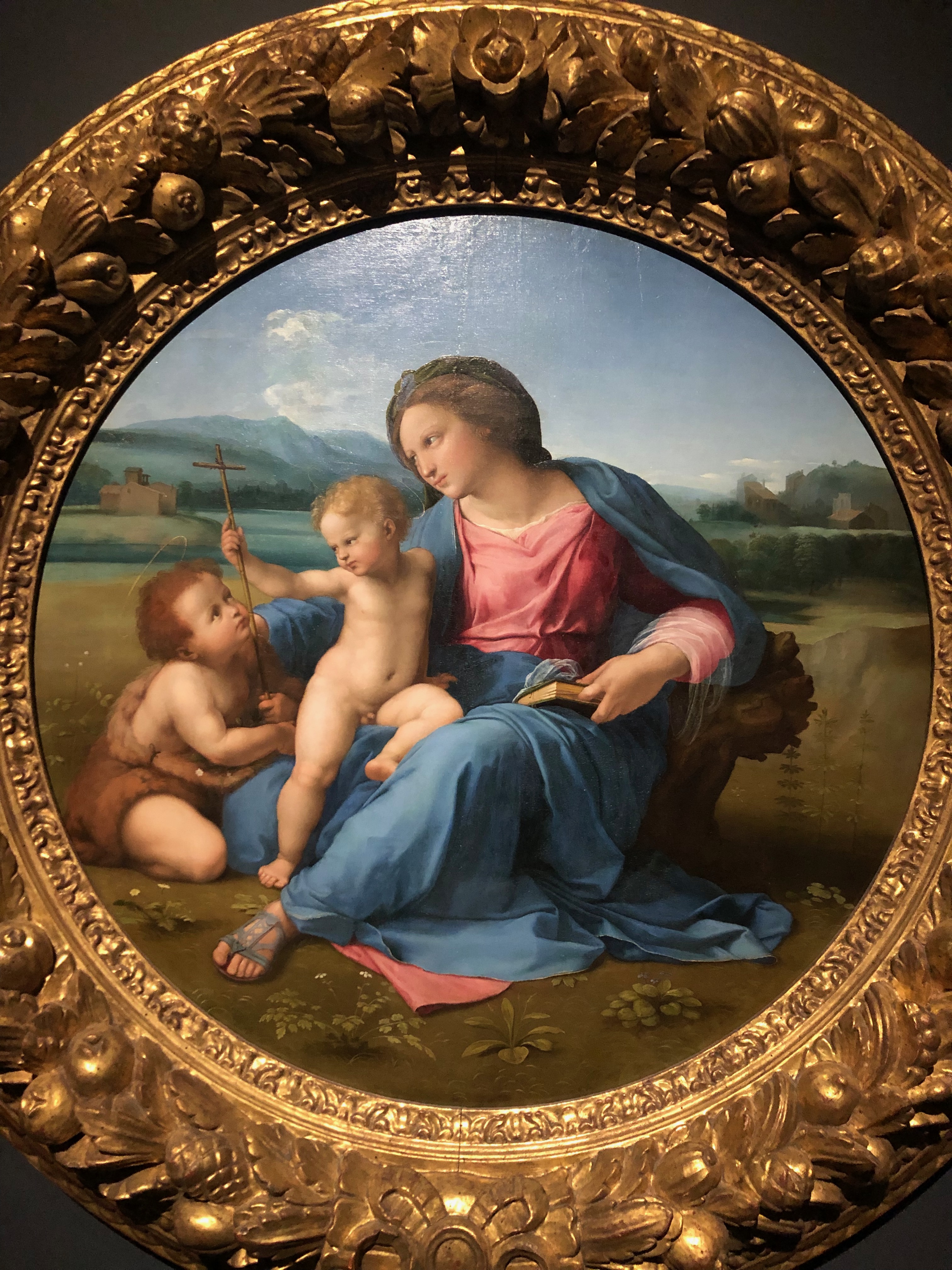
The next phase of the exhibition focused on a selection of Madonna and Child paintings commissioned by private patrons, probably for devotion in their homes. These simple scenes of Our Lady with the child Jesus, often joined by the child John the Baptist, combine reverence for the Holy Family with very human interactions. Baby Jesus is often portrayed squirming out of Mary’s arms as he reaches to grab objects near him. Mary serenely contains him, sometimes engaging and entertaining him, sometimes having just looked up from her own reading. The “Alba Madonna” is one such scene. Mary, Jesus, and John the Baptist are grouped together in a field. Jesus and John the Baptist are fascinated by a cross-shaped rod that John is holding. Mary is painted with a gracefulness and beauty that shows her holiness in this ordinary family moment and Raphael’s devotion to the Virgin.
The next major phase of Raphael’s career began with his move to Rome and papal commissions, beginning with Pope Julius II’s stanze in the Vatican Palace in 1508. Drawings and studies for these paintings were included in the exhibit, but it also presented a challenge: these frescoes, probably Raphael’s most famous works of art, could not be relocated to New York City. Instead, a room was set up to the exact dimensions of the stanze, and projectors showed the paintings on all four walls, rotating between the Stanza della Segnatura (with the School of Athens and Disputation of the Holy Sacrament), the Stanza Eliodoro, and the Stanza dell’Incendio del Borgo. While it was helpful to see the composition of the paintings within the space, the digital projections of the frescoes seemed underwhelming compared with so many actual paintings in the adjacent rooms.
Two more large altarpieces in the exhibit showed Raphael bringing his style of interaction between figures into these usually more static devotional altarpieces. In the Madonna of the Fish, the Madonna and Child Jesus are joined by the Archangel Raphael and Tobias holding the fish that would exorcise a demon and bring healing to his father. On the other side of Mary, Saint Jerome is holding a bible and a lion rests calmly at his feet. Baby Jesus, again in motion, reaches toward the fish and has his other hand on a page of Saint Jerome’s Bible, perhaps alluding to the Book of Tobit in the Old Testament.
In an altarpiece devoted to Saint Cecilia, the saint is shown in the center of the painting gazing up to a glorious scene of angels playing music in heaven. Broken musical instruments lie on the ground around her, as her focus has shifted from earth to heaven. An interesting grouping of saints surrounds her. On the left side of the painting, Saint Paul looks down, while Saint John and Saint Augustine are behind Saint Cecilia, looking at each other. On the right side, Saint Mary Magdalene holds a jar of oil and gazes out, seeming to ask the viewer, “Is your focus on earth or on heaven?” Raphael shows the communion of saints in communion with the Lord and also in relationship with one another.
The most impressive items in the exhibit in size were in the final large room—three floor-to-ceiling tapestries based on designs by Raphael. These ten-foot-tall and over twenty-foot-wide tapestries were copies of the set designed by Raphael for the walls of the Sistine Chapel, and they depict scenes of the apostles from Scripture.
One additional small room focused on Raphael as an architect. Much less emphasis was placed on Raphael’s own architectural work here, with just one fragment of a plan study for Saint Peter’s Basilica. However, a surprise was in store for those interested in architectural drawings—two of Bramante’s famous red-chalk plan drawings of his design for the new Saint Peter’s were included.
The exhibit was ambitious in its gathering together of pieces from collections across many countries. Its narrow focus on Raphael allowed a depth of engagement with his development over his 37-year lifetime. This engagement is aided by the exhibition catalogue, a masterpiece in itself. Much more than just a list of the artworks included in the exhibition, the 400-page book is also the work of curator Carmen C. Bambach, who wrote essays corresponding to each section of the exhibit. Other analyses of Raphael are provided by several distinguished contributors. The book helps to mitigate the only shortcoming of the exhibit: its brief timeframe. Readers of the book will likewise be immersed in the life and work of this Renaissance master.