Basilica Sancti Petri
by Compiled by SAJ, appearing in Volume 50
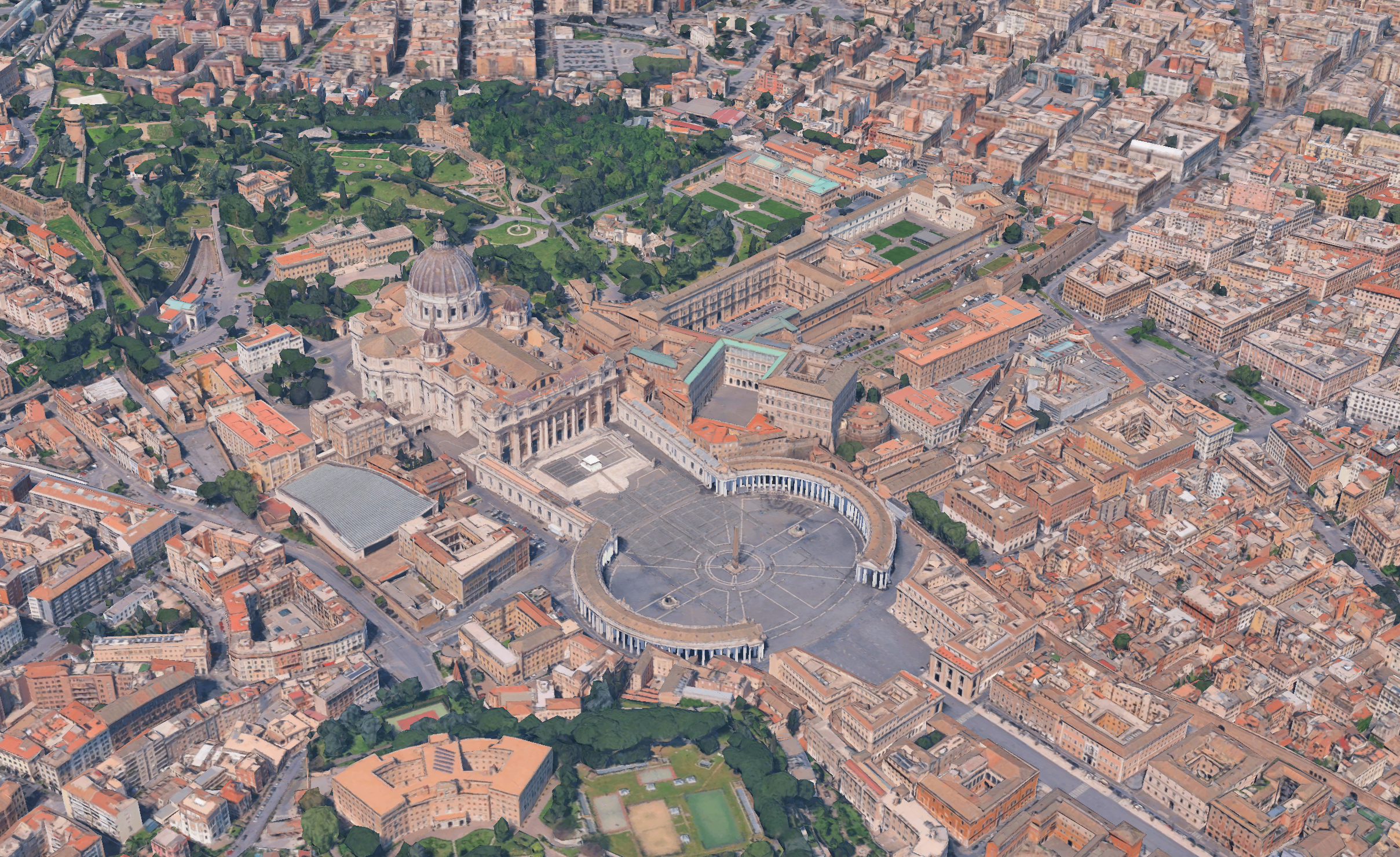
- 40 - Emperor Caligula has an obelisk shipped to Rome from Heliopolis, installing it in a then-under-construction circus on Vatican hill.
- 65 - On the spina of the Circus of Nero, Saint Peter is crucified upside-down. It is likely that one of the last things he sees is the obelisk Caligula had installed. Peter’s remains are buried in the nearest cemetery—the Vatican Necropolis, across from the circus. Christians gather secretly to worship at the site.
- 313 - Constantine passes the Edict of Milan. The Roman persecution of Christians ends.
- c. 326-337 - A major church is begun above the tomb of Saint Peter on Vatican Hill. A pre-existing shrine to Peter is incorporated into the new building.
- 337 - Constantine’s son Constans assumes rule in Italy and oversees the majority of construction for the first Saint Peter’s Basilica.
- c. 350 - The Old Saint Peter’s Basilica is completed as a massive, five-aisled, T-shaped building on the remains of the Vatican Necropolis. Saint Peter’s shrine is surrounded by bronze and porphyry columns, some of which are described as “vined,” or twisted.
- c. 600 - Pope Gregory I develops the crypt of Saint Peter’s into a ring-shaped passage to allow pilgrims access to the tomb of the first pope directly beneath the high altar of the basilica.
- 800 - Pope Leo III crowns Charlemagne the “Emperor of the Romans” on Christmas Day in Saint Peter’s Basilica, beginning the Holy Roman Empire.
- 846 - Saracen invaders sack Saint Peter’s Basilica and carry off many holy images and other treasures.
- 1045 - Pope Gregory VI appeals to all of Christendom for money to prevent the basilica from collapsing. Almost no one responds, except a single French duke.
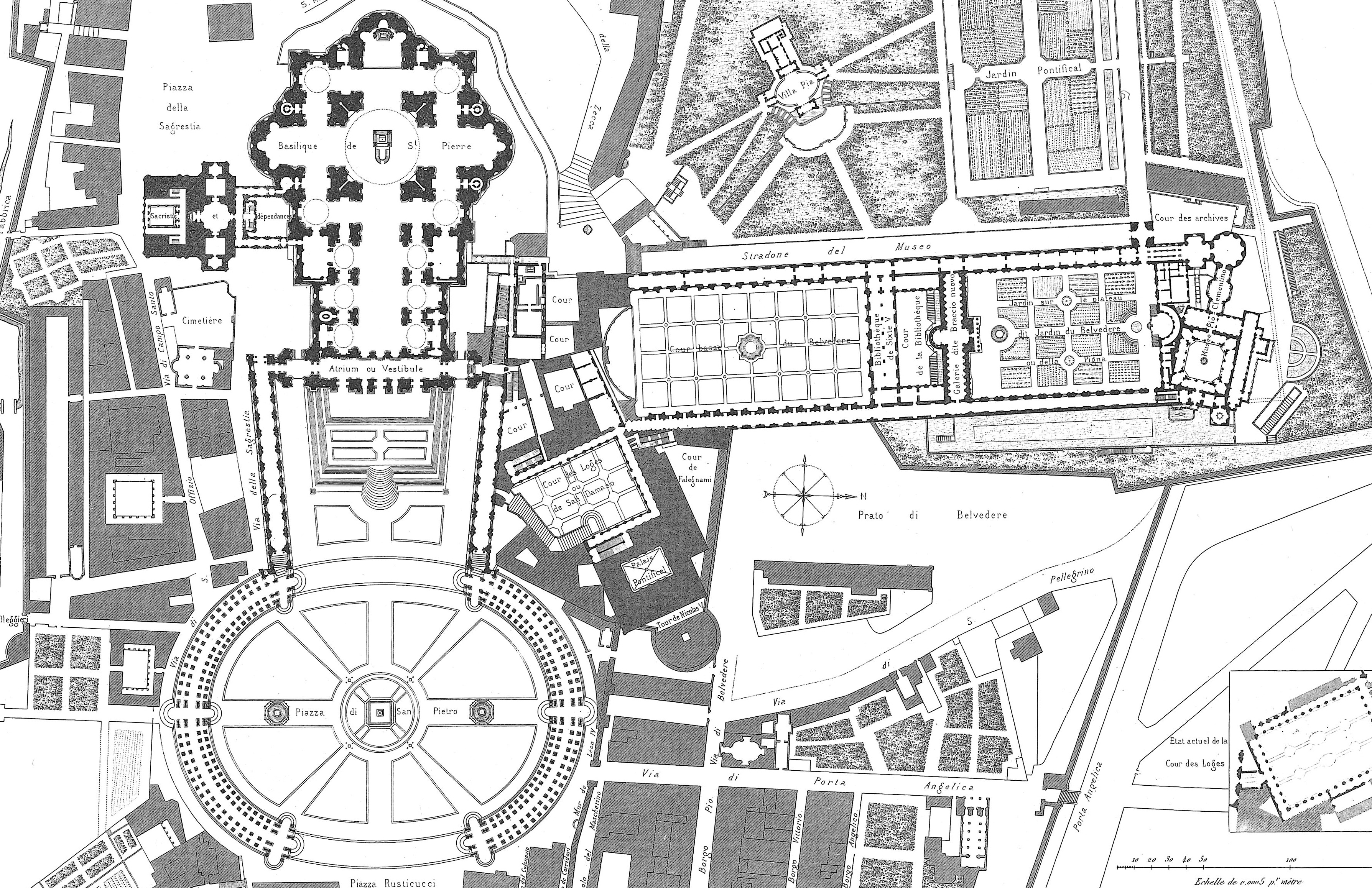
- c. 1230 - Pope Gregory IX has to issue a bull excommunicating anyone who uses the walls of Saint Peter’s Basilica as a quarry.
- 1305 - Giotto completes his Navicella mosaic on the courtyard facing the old basilica. This mosaic is widely admired throughout the medieval world.
- 1309 - The popes abandon Rome for Avignon in France, leading to a period of slow decay in Old Saint Peter’s. Without its executive head, Rome slides into chaos as aristocratic families fight for power. Saint Peter’s Basilica falls into a period of neglect.
- 1377 - Under Catherine of Siena’s influence, Gregory XI returns to Rome from Avignon. The election of the Roman pope Urban VI spurs French cardinals to elect their own pope, Antipope Clement VII. Although a Pope was now in Rome, the resulting Western Schism drags on until 1417.
- 1417 - The Western Schism ends with the election of Martin V. The returning full might of the papacy brings with it new symbols to assert papal power in the eternal city, with renewed emphasis placed on Saint Peter’s in the Vatican over Saint John Lateran as the most favored papal church.
- 1447 - Nicholas V is elected pope. The southern wall of the basilica leans nearly six feet out of plumb. Leon Battista Alberti, in a report on the state of the church, warns that the slightest earthquake could cause the whole building to tumble.
- 1450 - During the Jubilee year, the Ponte Sant’Angelo near Saint Peter’s collapses, killing 200 pilgrims. This disaster looms large in Pope Nicholas V’s mind, especially given the poor state of the basilica itself. He sets out to repair the basilica, but comes to the conclusion that the entire building must be replaced. He chooses Bernardo Rossellino to design the new building. Rossellino’s plan draws precedent from the building it was to replace, with the major new suggestion of a dome over the crossing.
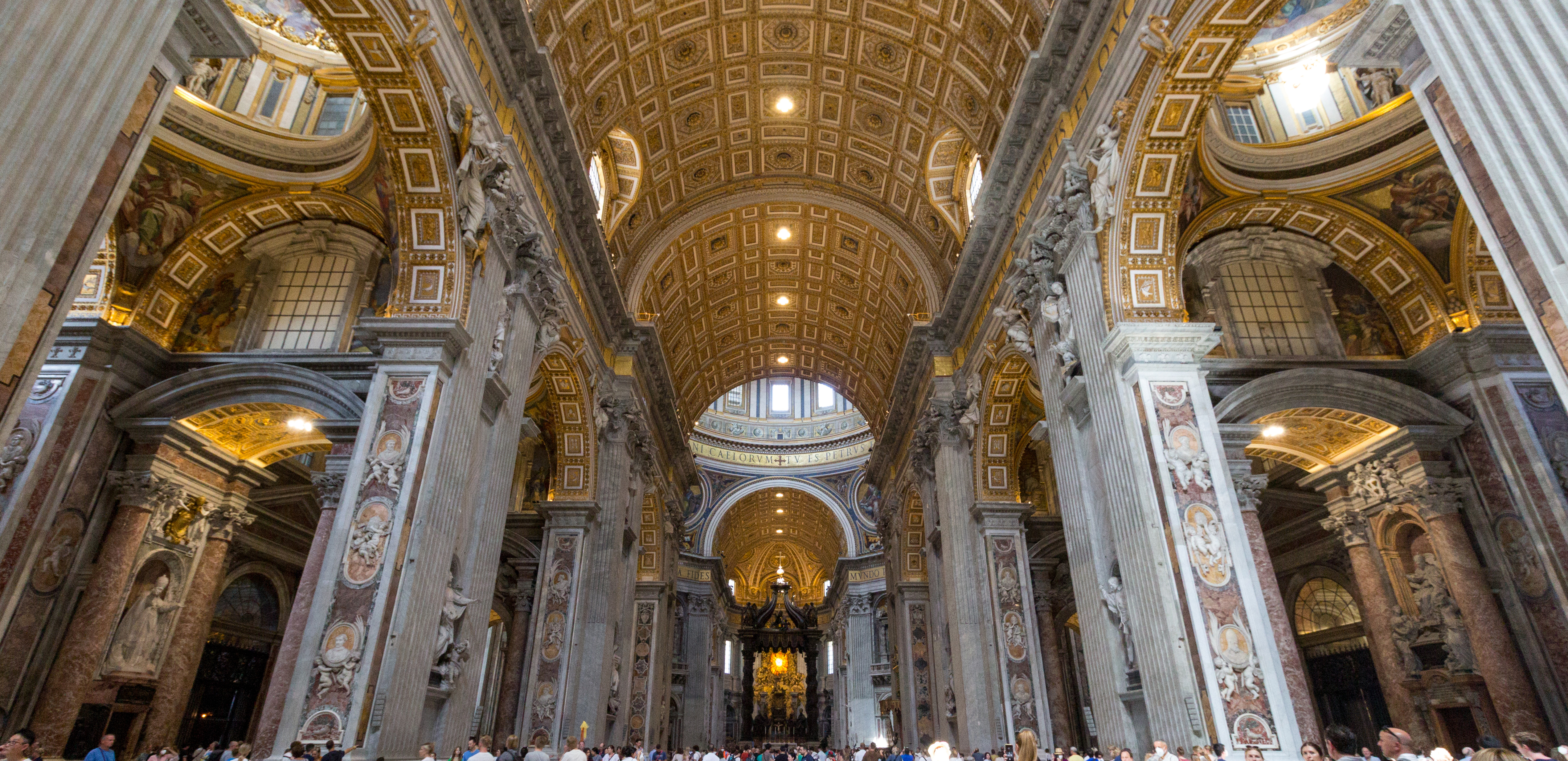
- 1455 - With the wall of the choir built to about six feet high, and the first demolitions beginning, Nicholas V dies. Rossellino’s plan is abandoned. The new pope, Callixtus III, is not very interested in the project and no work gets done during his tenure. The same slow approach continues for nearly fifty years.
- 1503 - Pope Julius II is elected and sets out to finish what Nicholas V started. He commissions Giuliano da Sangallo in 1505 to redesign the entire basilica in the grandest way possible.
- 1506 - On April 18, Pope Julius II ceremonially lays the foundation stone of the new Saint Peter’s.
- 1506-1513 - Donato Bramante replaces Sangallo as architect. Bramante’s design for the building is simpler than Sangallo’s, and its main distinguishing contribution is a tempietto-like dome supported by massive crossing piers. He works quickly and, in some ways, carelessly. Many ornaments and monuments from the old basilica are destroyed as parts of it are torn down.
- 1513 - Pope Julius II dies and is replaced by Leo X. At seventy years old, Bramante is feeble and unable to continue as architect. He is replaced, once again, by Giuliano da Sangallo and Bramante dies four months later.
- 1514 - Sangallo dies, and Raphael is hired as the new architect.
- 1520 - Raphael dies at 37. Baldassare Peruzzi is put in charge.
- 1527 - Charles V sacks Rome, and Peruzzi flees. Rome is laid to waste, relics are sold and defaced, and nearly two thirds of buildings are destroyed.
- 1534 - Peruzzi is summoned back to Rome from Siena, where he has been living the past seven years.
- 1536 - Peruzzi dies, and Antonio da Sangallo the Younger submits a plan which combines aspects of Bramante’s, Raphael’s, and Peruzzi’s proposals into a cohesive whole. He is hired as the next architect of Saint Peter’s. His greatest contribution is strengthening Bramante’s piers beneath the yet-to-be-built dome.
- 1546 - Sangallo the Younger retires. Pope Paul III hires the seventy-two-year-old Michelangelo as the next architect.
- 1557 - Michelangelo writes “I believe… that God entrusted me with this labor.”
- 1564 - With the dome built only up through the drum, Michelangelo dies. Pope Pius IV is distraught, and can’t bring himself to hire a replacement for a few months. Eventually he hires Pirro Ligorio as the new architect, with the strict instructions to not deviate from Michelangelo’s plans for the dome.
- 1566 - Pope Pius IV dies and Pius V is elected. Ligorio, thinking to take advantage of this administrative change, tries to deviate slightly from Michelangelo’s plan for the dome and is fired immediately. Jacopo Vignola, his successor, had worked under Michelangelo in the 1550s.
- 1573 - Vignola dies, and Giacomo Della Porta becomes architect of Saint Peter’s.
- 1585 - Under Pope Sixtus V, Della Porta successfully deviates from Michelangelo’s original dome, designing the cupola and changing the profile slightly to be more egg-like.
- 1586 - On a warm April 30, the 330-ton obelisk, which until now has been in its original location to the south of the basilica, is moved by Domenico Fontana to the front of the basilica using a complex system of ropes, pulleys, and rollers.
- 1590 - The dome is completed.
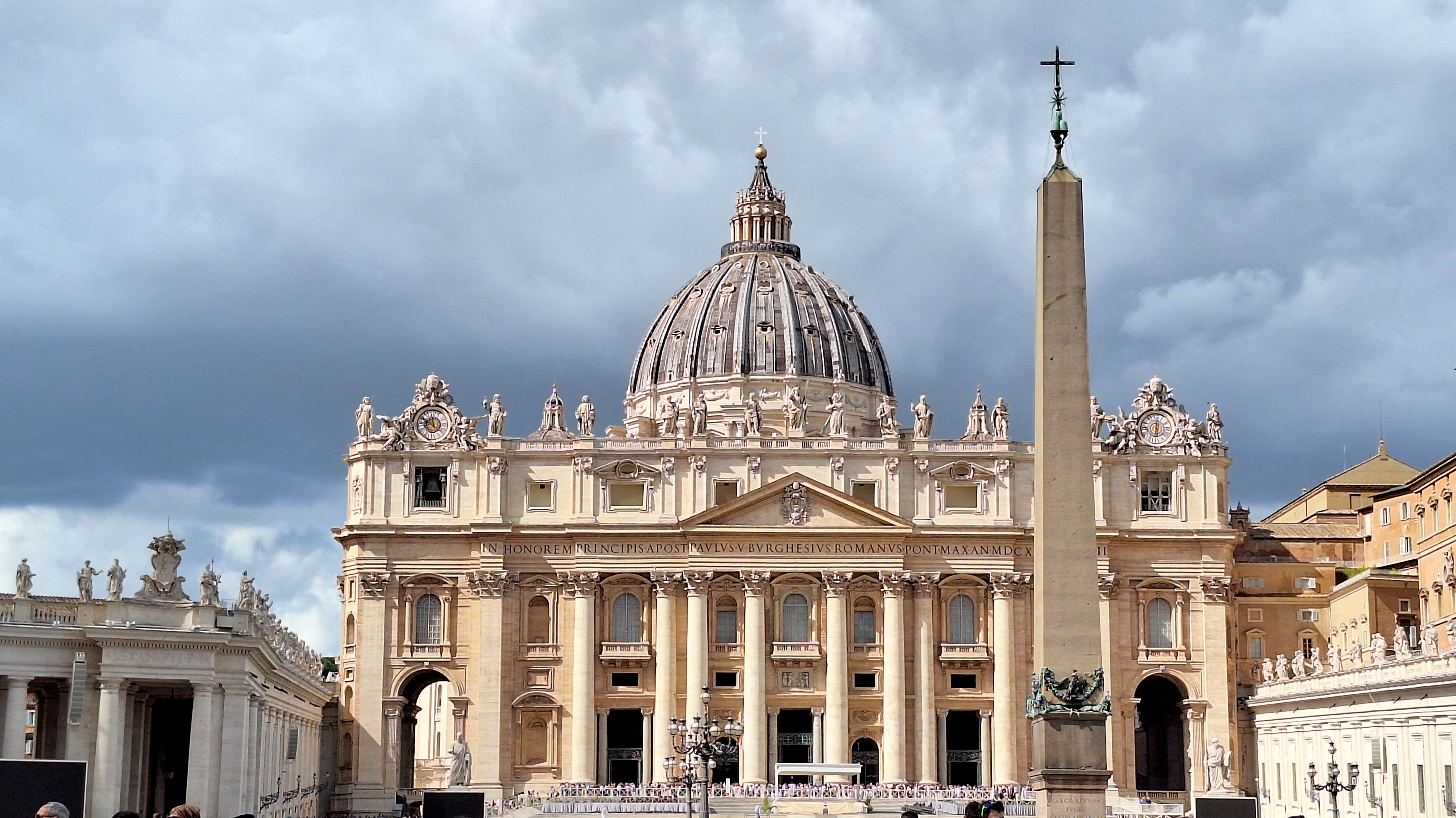
- 1593 - Pope Clement VIII sees the cross finally put in place atop the dome.
- 1602 - Carlo Maderno, the nephew of Domenico Fontana, is appointed architect of Saint Peter’s.
- 1606 - Construction begins to expand into the nave. The remaining parts of the old basilica are torn down, beginning on Ash Wednesday.
- 1608 - The façade, designed by Maderno, is begun.
- 1615 - The nave is completed, the partition wall is torn down, and Mass is celebrated in the whole building on Palm Sunday.
- 1624 - Pope Urban VIII asks Gian Lorenzo Bernini to design a new baldacchino for the central altar over the tomb of Saint Peter.
- 1626 - On November 18, Urban VIII consecrates Saint Peter’s Basilica.
- 1629 - Pleased with the baldacchino, Urban appoints Bernini as the successor to Maderno as architect of Saint Peter’s.
- 1656-1667 - Bernini designs the massive oval colonnade around Saint Peter’s Square, centered on the ancient obelisk.
- 1666 - Bernini’s Cathedra Petri sculpture is completed in the apse at the end of the nave.
- 1680 - Bernini dies. Cracks are observed in the drum and the dome, which likely have been appearing since it was first completed.
- 1730 - Earthquakes nearby further widen cracks in the dome.
- 1740s - At the direction of Pope Benedict XIV, Luigi Vanvitelli encircles the dome with five iron chains. Cracks stop widening.
- 1870 - Pope Pius IX blesses his troops before they attempt to defend Rome from the Italian nationalists in Saint Peter’s Square. Days later, the Papal States cease to exist.
- 1929 - Vatican City is established by the Lateran Treaty. The only one of the four papal basilicas to be completely within Vatican territory is Saint Peter’s.
- 2026 - November 18 celebrates the 400th anniversary of Saint Peter’s Basilica.