Architect and Artist
by Mason Roberts, appearing in Volume 50
As one of the most prolific architects of the nineteenth century, known for both his revolutionary ideas about historic buildings as well as his body of built work, the French architect Eugène-Emmanuel Viollet-le-Duc (1814-1879) has made a recent return to prominence largely due to the rebuilding of Notre-Dame de Paris after the 2019 fire, which included Viollet-le-Duc’s iconic 1857 spire over the crossing. This naturally set a high bar for the recent Viollet-le-Duc: Drawing Worlds Bard Graduate Center exhibition on Manhattan’s Upper West Side, which ran from January 28 to May 24, 2026.
The exhibition spanned four floors, exhibiting a wonderland of over 200 of Viollet-le-Duc’s original drawings and objects arranged chronologically across his career. This was the first major United States exhibition of Viollet-le-Duc’s work, and the presentation of the drawings and adjacent placards presented Viollet-le-Duc as a revolutionary in his field who characterized the built past as part of a living, breathing tradition.
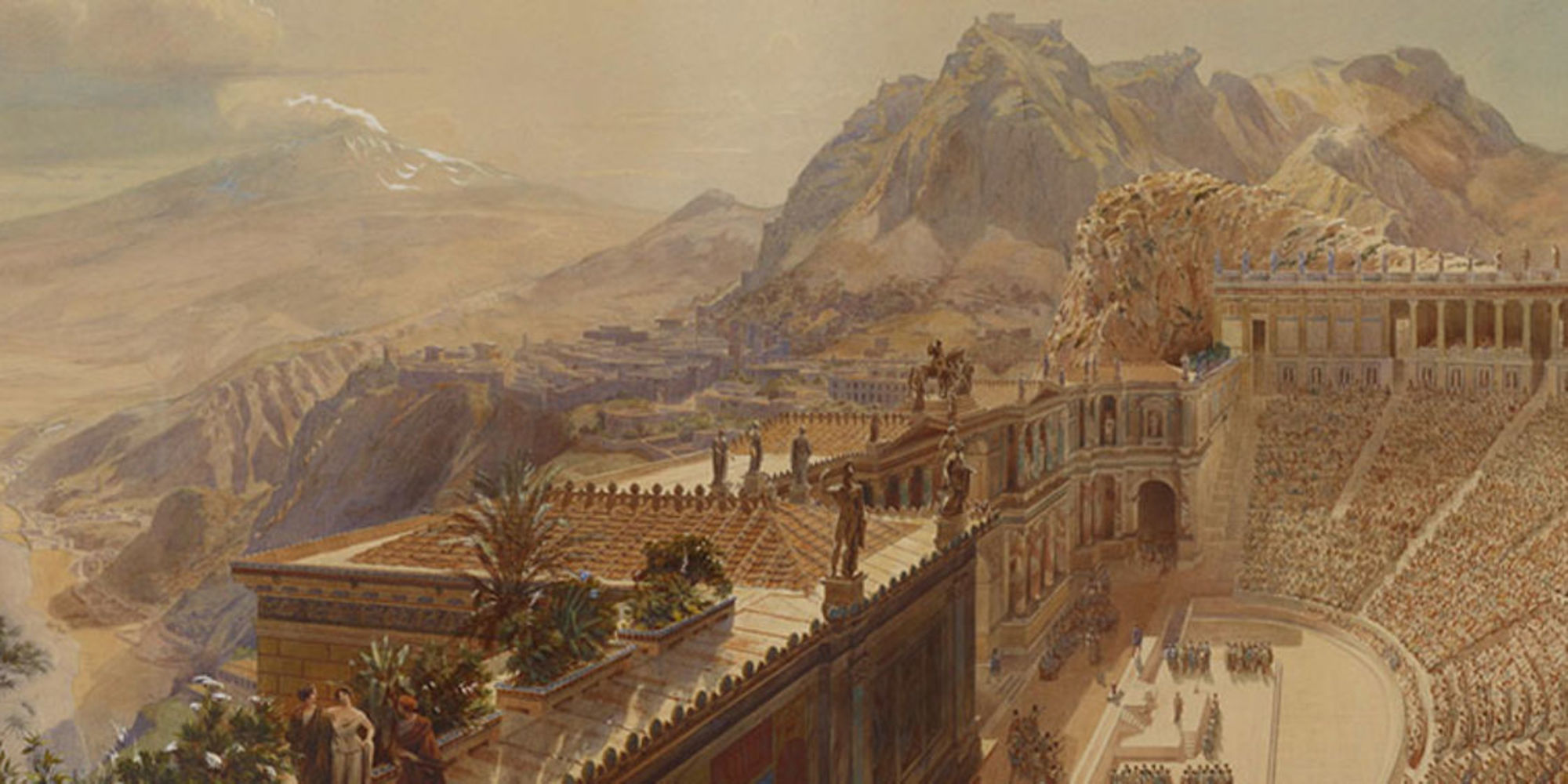
The first floor of the exhibit presented Viollet-le-Duc’s early works and his formation as an architect. He famously declined admission to the École des Beaux-Arts, choosing instead to educate himself through independent travel and the study of historic architecture throughout France and Italy. It was during these travels that he gained an appreciation for the creativity and ingenuity of medieval architecture. His elevation drawings of the fourteenth-century marble-clad façades of the Duomo in Florence emphasize its vibrant polychromy, and his reconstructions of great structures from antiquity reject the rigid orthographic standards of the École des Beaux-Arts in favor of a more “painterly” approach. His depiction of the great amphitheater at Taormina depicts a conjectural performance of Aeschylus’s Eumenides in perspective with seats filled with spectators dressed in colorful period garb.
The second floor of the exhibit contained perhaps the most interesting drawings in the exhibition: Viollet-le-Duc’s renderings of Notre-Dame de Paris. Working with architect Jean-Baptiste Lassus, Viollet-le-Duc won a competition in 1844 to restore the cathedral, which had suffered decades of neglect and the infamous desecration of the structure during the French Revolution. Influenced by Victor Hugo’s recent publication of The Hunchback of Notre Dame, Lassus and Viollet-le-Duc’s competition drawings took great liberties in seeking to give Notre-Dame stylistic unity, even if, as Viollet-le-Duc conceded, such a unity had never existed at any given moment in history. In addition to changes to the iconic rose windows and the replacement of much of the masonry, his drawings convey stylistic additions which were intended to enhance the medieval architecture: taller pinnacles with decorative crockets, unified triforium windows, fantastical chimeras along the roofline, and, of course, the iconic spire at the crossing that was significantly taller and more decorative than the thirteenth-century spire removed a century earlier. Such enhancements to Notre-Dame represent Viollet-le-Duc’s vision of medieval architecture as a living and evolving tradition in contrast to his English contemporary John Ruskin’s more static view of the preservation of historic buildings.
The third floor of the exhibit moved beyond Viollet-le-Duc’s architectural career and exhibited his drawings of geological, geographical, and anthropological subjects. Perhaps the most unusual and idiosyncratic were his drawings reflecting his interest in the pervading racial theories of his time. Caricatures depicting human skull shapes in a purported evolutionary progression back to primates flanked a series of drawings of highland cabins representing what Viollet-le-Duc imagined to be the original dwellings of the “Aryan” ancestors of the “European Race.” In describing these drawings, the exhibit editorialized such depictions as “highly problematic” and “repugnant.” While this certainly may represent the views of most, such terms bring into question the purpose of such an exhibition: to present material objectively? To instill a particular moral framework?
As a conclusion to the exhibit, the fourth and final floor examined Viollet-le-Duc’s influence on our modern-day understanding of medieval architecture, including the whimsical caricatures of medieval buildings in fairy tales, the arts, and even video games. A small vignette discussed the reconstruction of Notre-Dame over the last five years and displayed a mold of the phoenix-like rooster that now adorns the rebuilt crossing spire. This served as an apt conclusion to a well-framed exhibit of Eugène-Emmanuel Viollet-le-Duc’s body of drawings and his views of Notre-Dame as a part of a living and evolving tradition. One hopes that this exhibit will serve as a catalyst for future exhibitions devoted to the work of other prolific and influential ecclesiastical architects.