The Pope and the Mathematicians
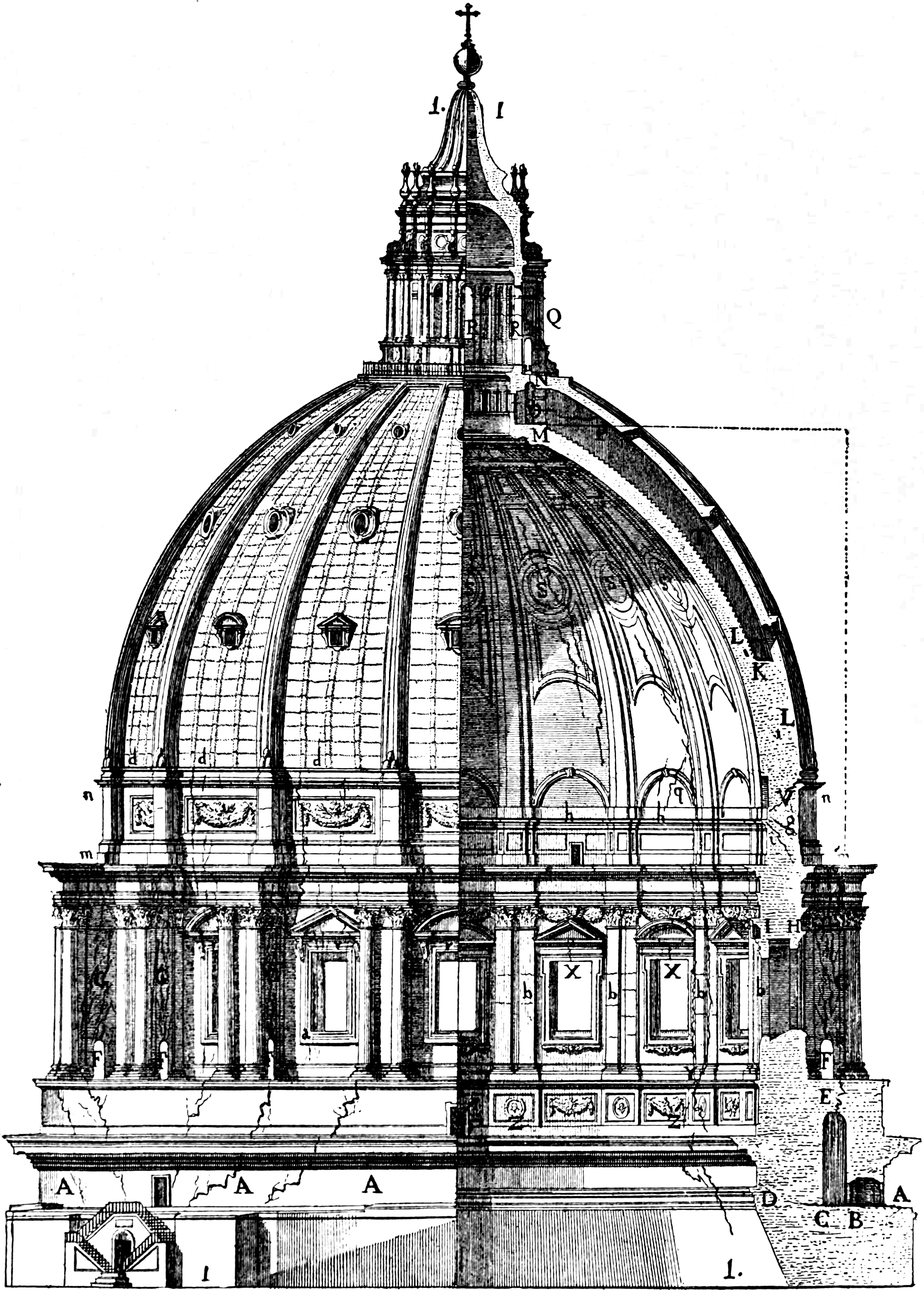
The great domes of Christendom rank among humanity’s greatest technical achievements, yet they were built long before anyone knew how to calculate such things as thrust, stresses, or load paths. In Saving Michelangelo’s Dome: How Three Mathematicians and a Pope Sparked an Architectural Revolution, Wayne Kalayjian proposes that the discipline of modern engineering did not truly emerge until one of those domes threatened to collapse. Kalayjian, a civil and structural engineer who lectures at the University of Southern California, recounts the story of the alarming cracks that developed in Michelangelo’s great dome at Saint Peter’s Basilica and the providential confluence of talented men who collaborated to fix it. More than a historical survey of the eighteenth-century repairs to the dome, Saving Michelangelo’s Dome is an account of the emergence of engineering as a distinct intellectual discipline. It attempts to pinpoint the moment when inherited rules of craft first gave way to science capable of explaining, predicting, and ultimately safeguarding the greatest works of architecture.
Kalayjian’s principal thesis is that the crisis surrounding the dome of Saint Peter’s Basilica became the testing ground for a new empirical methodology for approaching construction. He begins the story with the singular man whose exceptional qualities rendered the repairs and accompanying revolution in thought possible: Pope Benedict XIV. A talented administrator with “a willingness to challenge conventional thought,” Benedict XIV acceded to the papal throne in 1740 and was soon confronted with an extraordinary problem: the dome of Saint Peter’s was threatening to collapse. The construction of the basilica had unfolded across more than a century, and its design had passed through the hands of a succession of Renaissance masters. Its crowning jewel was the dome designed by Michelangelo but modified and executed after his death by Giacomo della Porta and Domenico Fontana. The dome had been rushed to completion under the reign of Pope Sixtus V, and within decades ominous cracks had started to appear. Kalayjian speculates that this could have been due to hurried workmanship or perhaps to frequent seismic activity. Whatever the cause, by Benedict XIV’s pontificate the situation was perilous. The Vatican architect, Luigi Vanvitelli, prepared a report for the pope documenting hundreds of cracks that had spread throughout the inner and outer shell of the dome and its supporting drum. Faced with the troubling prospect of the potentially imminent collapse of the preeminent symbol of Christendom, Benedict XIV did something remarkable: he turned to mathematicians to solve an architectural problem.
This approach was revolutionary in its implications. The three mathematicians—one Jesuit and two friars in the Order of Minims—from whom Benedict XIV sought advice knew very little about the practical art of construction, but they brought to the problem of the dome of Saint Peter’s something that no capomaestro was able to provide: an understanding of the latest developments in statics and Newtonian physics. The mathematicians inspected the dome and compiled their findings in a thirty-six-page report that relied on contemporary scientific theory to diagnose the cracks and propose a remedy. According to Kalayjian, their examination provided “a plausible and facts-based analysis that for the first time explained the damage to Michelangelo’s dome in a coherent and unified way.” Benedict XIV ultimately rejected their recommendations in favor of a proposal by Giovanni Poleni, a mathematician and scientist from Padua whose solution involved encircling the dome with enormous iron tension rings at five different levels. These rings were intended to restrain the outward thrust of the masonry and forestall further movement. Kalayjian emphasizes that Poleni’s solution, though grounded more in established practice than in mathematical mechanics, did not diminish the significance of the mathematicians’ work in bringing emerging scientific methodology to bear on the ancient problem of construction.
Kalayjian rightly celebrates the birth of engineering as a professional discipline, but he occasionally overstates the contrast between the scientific engineer and the pre-modern architect. At many points in the text, he refers to the master builders of old as relying on “intuition and subjective judgment” when dealing with the complicated structural forces acting on a building. This is true in a sense. But architects before the eighteenth century were not inventing ex nihilo. They were the inheritors of an enormous body of practical knowledge, and while that knowledge wasn’t expressed in complicated mathematical equations, neither was it arbitrary. Our post-Enlightenment disposition tends to privilege precise, data-driven knowledge as the highest form of understanding, but architectural practice prior to the eighteenth century operated on a different—not lesser—form of rationality: practical wisdom, what Aristotle would call phronesis, grounded in tradition and uniting beauty, structure, and craft into a single praxis.
These slight criticisms, however, do not overshadow the book’s achievement, and even readers who question some of Kalayjian’s presuppositions will likely enjoy this illuminating look at a seldom-treated chapter of architectural history. Saving Michelangelo’s Dome should appeal both to practitioners and amateurs alike. Kalayjian explains structural concepts in plain language, giving readers enough technical detail to appreciate the scope of the damage and repairs without requiring much specialized knowledge. It will be especially rewarding for readers who enjoy seeing technical ideas placed within their broader historical context.